
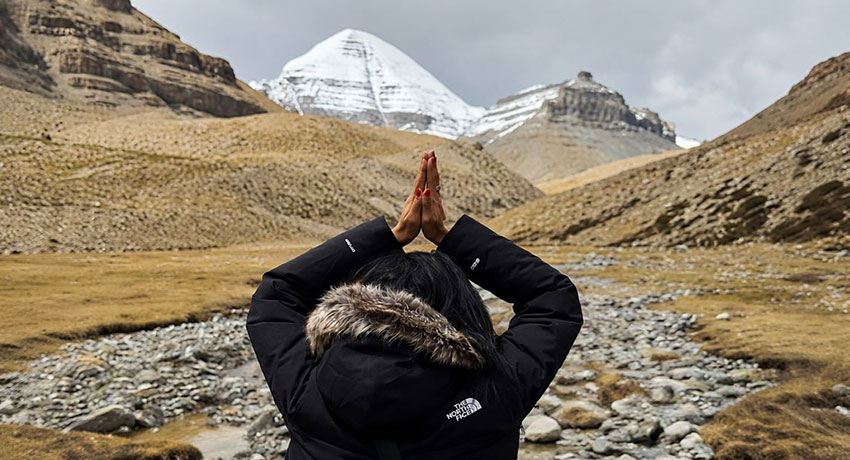
KAILASH: The Mountain That Finds You.
Three Kailash journeys. Seven years. What I learned that no book could have taught me.
Every time I try to describe Kailash, I fail. Not because words are inadequate, but because Kailash does something to words. It makes them feel small in a way that nothing else does. No scripture prepares you for it. No traveller’s account does justice to it. You stand before that mountain and something in you goes completely quiet without being asked. Not the quiet of peace, the quiet of recognition. Like something ancient in you has finally seen its own face.
I have now stood before Kailash three times across seven years. And three times the same thing happened. Everything I thought mattered stopped mattering.
What I am sharing in this article are not borrowed ideas or scriptural interpretations. These are my own learnings, earned through three Kailash Yatras, through the physical demands of the Parikrama, through grief carried up on a mountain, and through the slow, humbling process of having everything I thought I knew quietly dismantled by a place that does not negotiate.
But to tell you what Kailash taught me, I have to take you back to where this story began. To a five year old girl sitting with her grandmother, asking one question. Where does God live? And her grandmother answering, without a moment’s hesitation. At Kailash. I did not fully understand what that answer meant at five years old. But something in me heard it as instruction rather than information. And from that moment, across every decade of my life that followed, one quiet certainty lived at the back of everything else. I will go there one day. It took me thirty five years to get there.
What Kailash Actually Is.
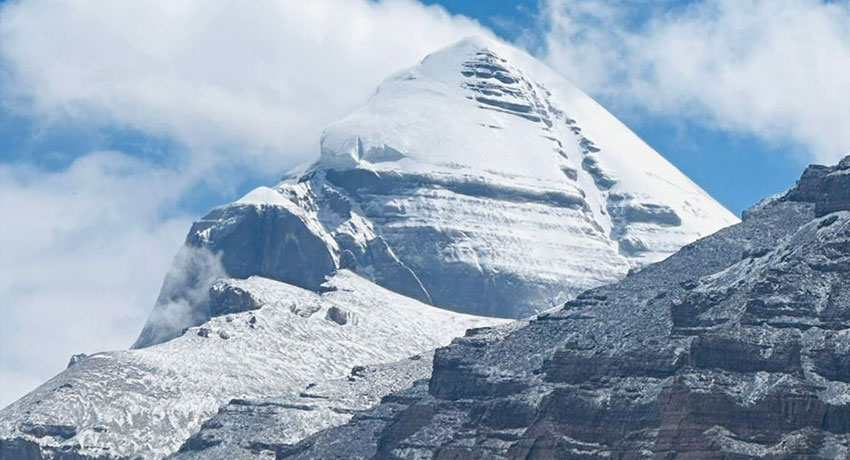
Kailash rises to 6,638 meters in the remote Ngari prefecture of Tibet. It is not the highest mountain in the Himalayas. Peaks far taller have been climbed, documented, and conquered by human ambition and modern mountaineering equipment. Kailash has never been climbed, and whosoever has tried to climb the mountain has never returned alive. After losing many climbers, everyone now agrees that Mount Kailash cannot be conquered. It is a mountain to be approached with humility, circumambulated with reverence, and experienced from the outside.
Kailash is one of the very few places on earth sacred to four major religions, each with its own beliefs, traditions and names for the mountain. In Hinduism it is called Kailash. In Tibetan Buddhism it is known as Gang Rinpoche, meaning Precious Jewel of Snow. In the ancient Bon tradition of Tibet it is called Tise. In Jainism it is known as Ashtapada, the site where their first Tirthankara attained liberation. Four religions, Four names. Four completely different theological frameworks. And yet all four arrive at the same mountain, drawn by the same inexplicable pull, circling it in reverence, each in their own direction, but all of them circling.
No single religion owns Kailash. Each faith recognizes it as a divine centre, a place where something beyond ordinary human experience becomes perceptible. It sits outside the boundaries of India, in Tibet, and yet is held with the deepest reverence by traditions that span the entire breadth of human civilization. If the Divine has a religion, Kailash disproves it.
Kailash is also the geographical source of four of Asia’s greatest rivers, the Indus, the Sutlej, the Brahmaputra and the Karnali, rivers that have sustained billions of human lives across thousands of years of civilization. The mountain that no tradition owns is the source from which so many civilizations drank.
SHIVA. And What That Name Actually Means.
Kailash is the abode of S. Not SHIVA as a mythological figure, though that form carries its own profound symbolism. SHIVA as the principle of pure consciousness that underlies all of existence. The awareness that was present before creation and will remain after it. The stillness at the absolute centre of all movement. The silence from which all sound emerges and into which all sound eventually returns.
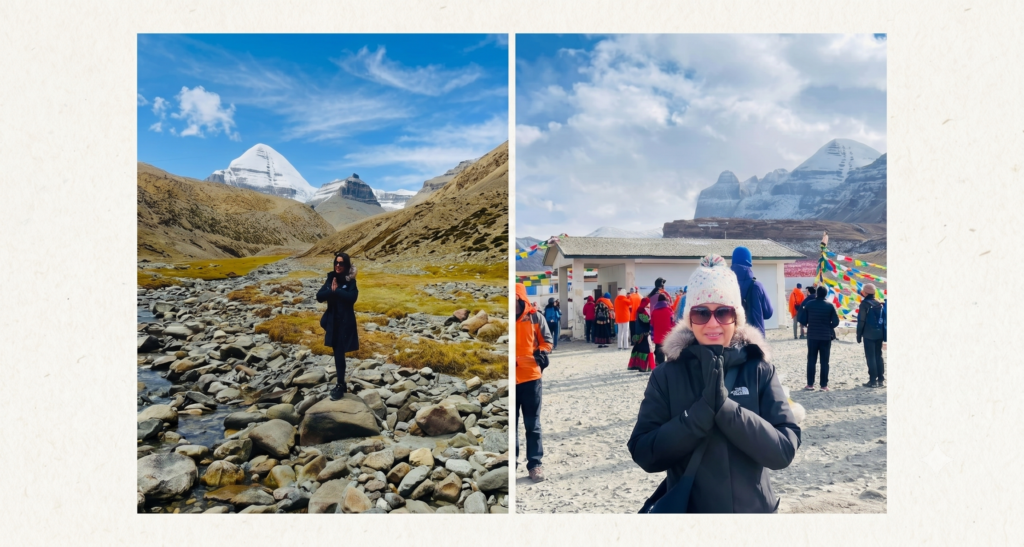
I have loved SHIVA since I was a child. Not as a deity to be appeased, but as supreme consciousness. As the one reality underneath all the forms that reality takes. What Hindus call SHIVA, Buddhists recognize in the fundamental nature of mind. What Sufis call the beloved within. What the Christian mystics described as the kingdom of God inside you. What quantum physicists are beginning to approach when they speak of consciousness as the ground of all being rather than a byproduct of matter. Different traditions, different languages, different centuries- the same pointing.
Kailash holds the concentrated energy of that principle. And every tradition that has ever found its way to this mountain has felt it, regardless of what name they brought with them. Because the energy does not respond to names. It responds to the quality of attention you bring.
Kailash Is SHIVA’s Body.
There is something about the shape of Kailash that stops you before you have taken a single step of the Parikrama.
It is a pyramid. Not approximately pyramid shaped. Not resembling a pyramid if you squint at it from the right angle. A near perfect four sided pyramid rising from the Tibetan plateau, its four faces aligned with the four cardinal directions, its geometry so precise and so symmetrical that it has led serious researchers and pilgrims alike to question whether nature alone could have produced it. I am not making a claim here. I am telling you what I experienced standing before it. It does not look like a mountain that was formed. It looks like a mountain that was placed.
In the Hindu tradition, Kailash is not merely the home of SHIVA. Kailash is SHIVA. Not a symbol of SHIVA. Not a metaphor for SHIVA. The mountain itself is understood to be the physical manifestation of SHIVA’s presence in the material world. The body of pure consciousness made into stone and ice and silence. When you stand before Kailash and feel that inexplicable stillness, that quality of recognition I described at the opening of this article, the tradition says you are not standing before a mountain and feeling something spiritual. You are standing before SHIVA himself and feeling exactly what you would feel if consciousness in its purest form stood directly before you.
The four faces of Kailash face east, west, north and south. In the Shaivite tradition these correspond to the four states of consciousness mapped in the Mandukya Upanishad. Waking, Dreaming, Deep sleep, and turiya- the witnessing awareness that underlies and contains all three. The mountain is not just sacred geography. It is a map of consciousness itself, rendered in stone, at a scale that makes your own smallness feel like a gift rather than a limitation.
Standing before Kailash, I did not feel I was looking at a mountain. I felt I was being looked at.
The Outer Kora and The Inner One.
Most people who go to Kailash are focused on one thing. Completing the Parikrama. Touching Dolma La pass at 18,600 feet. Reaching the highest point. Proving to themselves and to the world that their body made it. I did the same on my first visit. And I want to say this clearly from my own experience of three Yatras. I had missed the point entirely.
Kailash has two journeys inside it. Everyone talks about the outer one. The fifty two kilometre Parikrama. Three days around the mountain. Dolma La at 18,600 feet. That point every pilgrim measures themselves against. But the outer Kora is only the container. The inner Kora is what Kailash’s actual offering.
People prepare for Kailash by training their bodies. They build stamina. They acclimatize to altitude. They research the route and pack the right gear and consult doctors about altitude sickness. And all of that is necessary. Please do it. But nobody tells you what to do with the part of you that no training reaches. Because Kailash does not stop at your body. It walks straight past your physical preparation and sits down in front of everything you have been quietly avoiding for years. The grief you never finished grieving. The questions about your life you have been too busy to ask. The identity you built so carefully and the nagging feeling underneath it that it was never quite the real you.
It is not about who touches Dolma La. It is about whose heart opens somewhere between one breath and the next. It is about whose inner world shifts quietly and permanently while the feet are busy with the outer circuit. I have seen people complete the Parikrama physically and return home unchanged. And I have seen people struggle terribly with the outer journey and come back transformed beyond recognition. The mountain is not measuring your fitness. It is measuring your willingness to be honest with yourself in the space it creates.
Kailash is not a physical journey that happens to be spiritual. From my own direct experience across three Yatras, it is a spiritual journey that needs a body to make it. Your body is the vehicle. Your soul is the one travelling. And Kailash is interested in the passenger, not the vehicle. If the inner Kora does not happen, the outer one is just a very difficult walk.
The Three Journeys.
My first Yatra was in 2019, when I turned forty. I had been wanting to go since I was five years old. Thirty five years of longing. And when I finally stood before that mountain, something happened that I was completely unprepared for. Everything I had been carrying, not just from this life but from what felt like many accumulated lifetimes of weight, simply fell away. Not dramatically. The way a fever breaks. You do not notice the exact moment. You simply realize at some point that something heavy that was there before is no longer there. Kailash introduced me to myself. My real self. Not the self shaped by expectations and roles and the accumulated opinions of everyone who had ever told me who I was. Something underneath all of that. Something that had been waiting quietly for thirty five years to be seen.
My second Yatra was in 2025. A return to the place that had first shown me my own face. Deeper this time. Quieter. Less searching and more arriving.
My third Yatra was in 2026. Six weeks after losing my father. I carried his memory into that Parikrama the way you carry something precious. And I felt him with me throughout the journey, not only as grief, though grief was present in every step, but as presence. As if the same pull that had drawn me to Kailash since childhood had been quietly connected to him all along. As if this third journey was not only mine to make. I had immersed his ashes in the Ganga before I left. And I carried something of him to the mountain that his daughter had loved since she was five years old, asking her grandmother where God lives.
Lake Mansarovar and Lake Rakshastal.
Before the Parikrama begins, most pilgrims spend time at Lake Mansarovar. And the lake demands its own moment because no description of the Kailash experience is complete without it.
The Sanskrit name Manasarovar combines manas, meaning mind, and sarovar, meaning lake. It is understood as the lake born from the mind of Brahma, the creator. Hindu tradition holds that bathing in Mansarovar cleanses the accumulated weight of many lifetimes. Tibetan Buddhists call it Mapam Yumtso, the Invincible Lake, and regard it as the mother lake to Kailash’s father. The Bon tradition holds that its founder bathed in its waters. Four traditions. One lake. The same recognition across all of them that something about this water is not ordinary.
When you sit at the edge of Mansarovar the experience is genuinely difficult to explain. The water is a shade of blue that does not exist in ordinary life. The silence around the lake is so complete that it makes you aware of every sound you have been carrying inside you. Many pilgrims weep at Mansarovar without knowing exactly why. The lake does not ask you why. It simply holds the space for whatever needs to come out.
And then there is Rakshastal. Less than a kilometer from Mansarovar, separated only by a narrow natural channel called the Ganga Chhu, sits a lake that could not be more different from its neighbor if it had been designed specifically to be its opposite. Rakshastal is saline and lifeless. No fish survive in its waters. No plants grow on its shores. The ground around it is dry, rocky and windswept, with a quality of abandonment that you feel immediately and cannot quite explain. Mansarovar is perfectly circular, symbolizing the sun and cosmic harmony. Rakshastal is crescent shaped, symbolizing the moon and impermanence. One lake supports life. The other rejects it entirely.
According to Hindu texts, Ravana, the demon king of Lanka, performed his most extreme penance on the shores of Rakshastal. He stood in the waters and cut off his own ten heads one by one as offerings to SHIVA. SHIVA, moved by the ferocity of this devotion, granted Ravana immense power. And Ravana used that power to kidnap Sita and bring destruction upon himself, his kingdom and everyone who loved him. This is the story that Rakshastal carries. And it is one of the most honest stories in the entire tradition. Because it does not say that devotion guarantees good outcomes. It says that devotion without inner transformation, devotion driven by ego and the hunger for power rather than genuine surrender, gives you exactly what you asked for. And then shows you what that costs.
Standing between Mansarovar and Rakshastal, you are standing between the two possibilities that every human life contains. Devotion that dissolves the ego and devotion that feeds it. Prayer that comes from love and prayer that comes from wanting power. Surrender and ambition dressed as surrender. The two lakes are connected by the Ganga Chhu. Pure water flowing quietly from Mansarovar toward Rakshastal, as if the sacred is always moving toward the dark, offering itself, without being asked. Kailash shows you its full truth here. Not just the light. The shadow too. Because any tradition that only shows you the beautiful is not showing you reality.
What Kailash Takes From You.
People go to Kailash thinking it will give them something. A blessing. A healing. A spiritual experience to carry home and add to their understanding of themselves. From my own experience of three Yatras, I want to say something that may surprise you. Kailash does not give you anything new. It takes away everything false. And what remains after that subtraction is the only thing that was ever actually yours.
After each visit, the world looked different. Not darker, but more real. The things that had felt urgent before Kailash felt small after it. The things that had felt small, genuine presence, honest conversation, the quality of attention you bring to the people you love, felt suddenly and completely important in a way they had not before. The illusion does not disappear. The world remains exactly as it was. You change. And once you have experienced that stillness, that quality of sacredness that Kailash carries in the very air around it, a part of you keeps longing for what is real and finds it increasingly difficult to settle for what is not.
Status loosens its grip. Validation loosens its grip. The endless pursuit of things that were supposed to matter and somehow never quite did, all of it becomes lighter after Kailash. Not because you reject the world. But because you have touched something that makes the world’s illusions visible in a way they were not before.
The Realization That Three Yatras Built.
On my first Yatra I went to Kailash looking for SHIVA. Looking outward, toward something I believed existed at a specific geographical location, in a specific mountain, in a specific concentration of sacred energy. And Kailash received that seeking with complete patience.
By my third Yatra, something had shifted so fundamentally that I can only describe it this way. I stopped looking for SHIVA at Kailash. And I found him in the one place I had not thought to look across decades of devotion. Within.
This is my deepest personal learning after three Kailash Yatras. The search for the Divine outside is a never ending search. You will keep moving in circles, from one sacred site to the next, from one tradition to the next, always reaching toward something that seems to keep moving slightly beyond your grasp. Not because the Divine is hiding. But because you are looking in the wrong direction. The search must end within.
Not because Kailash is not real. Kailash is more real to me than almost anything else I have encountered in this life. But because what Kailash does, if you allow it, is turn your attention in the only direction where what you are searching for can actually be found. The energy that concentrates at Kailash and the energy that lives within you are not two different energies. That is why there is attraction between them. Like calls to like. The mountain does not give you God. It reminds you of what you already are.
What I Carry Down From The Mountain.
Three Yatras. Seven years. And this is what I bring back.
The Divine has no religion. No race. No geography. No language. No flag. It cannot be owned by any tradition or confined to any mountain, however sacred, however ancient, however powerful the energy it holds. But sometimes, in specific places on this earth, the distance between what we ordinarily perceive and what is always already present becomes thin enough to feel. Kailash is one of those places.
Not because God lives there and nowhere else. But because something about that mountain makes it easier to stop looking outward long enough to discover what was always looking back at you from the inside.
I journeyed to Kailash three times seeking SHIVA. Carrying my father’s memory on the third one, I finally understood the Upanishads ultimate truth: SHIVA wasn’t on the mountain, he was the one compelled to return. A realization that began the day a five-year-old girl asked her grandmother where to find God, and learned He dwells inside. 🙏
Sadhavi Khosla
@sadhavi on X • Sadhavi Speaks on Substack, Instagram and You Tube.
Har Har Mahadev. 🔱🙏