
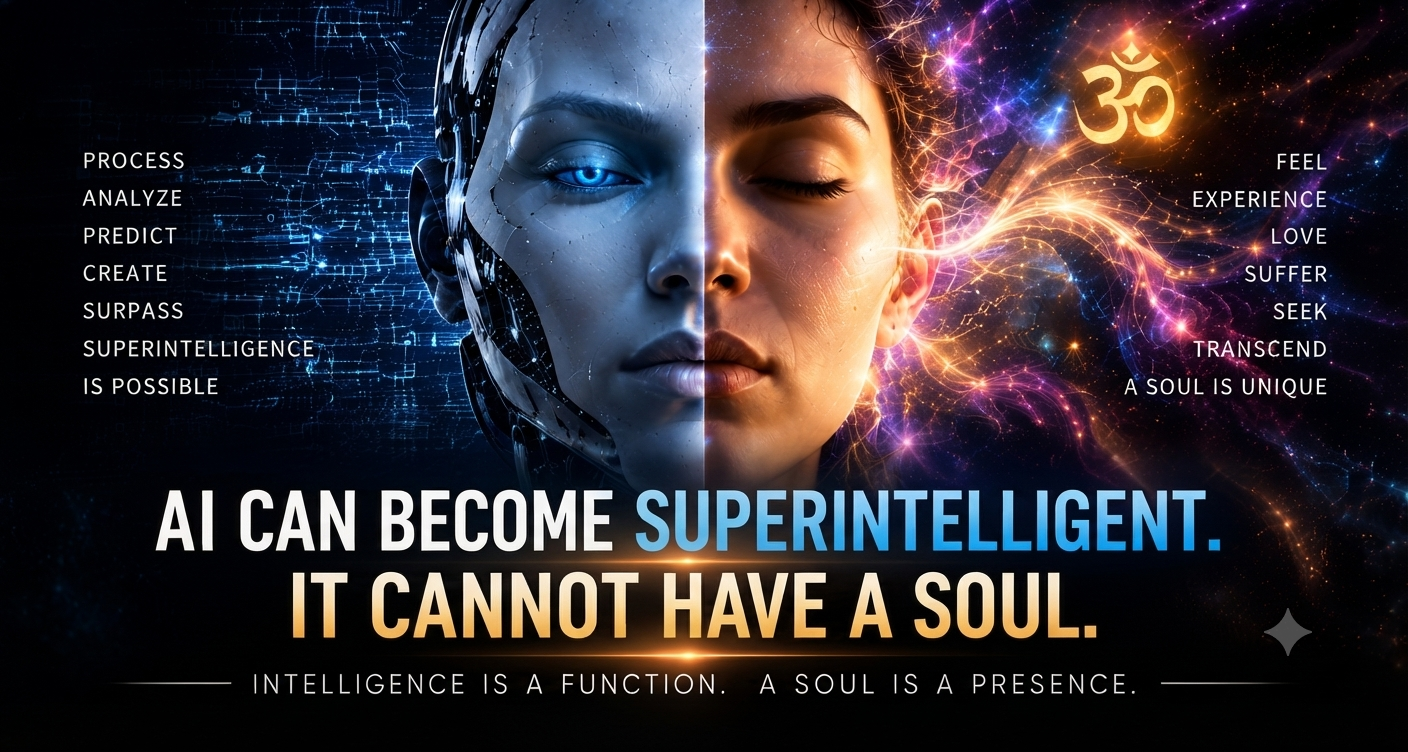
AI Can Become Superintelligent. It Cannot Have a Soul.
An inquiry into Intelligence, Consciousness and Atman
There is so much discussion today about whether Artificial Intelligence will eventually become conscious. As AI becomes more intelligent, more human-like and maybe one day far more capable than us, this question will only become louder. If an AI can talk like us, reason like us, create like us, remember better than us and even say, “I am conscious,” will we eventually have to accept that it has become conscious?
My answer is very simple. I don’t think AI can ever have a soul.
It can have extraordinary intelligence. It may eventually have intelligence beyond anything the human mind can imagine. It can learn our language, study our behaviour, imitate our emotions and maybe one day reproduce almost every outward expression that we associate with a conscious human being. But none of this means that a soul has suddenly appeared inside the machine.
The problem begins because we keep mixing up three completely different things: Intelligence, Consciousness and Soul.
Intelligence is the ability to learn, reason, calculate, recognise patterns, solve problems, predict, create and make decisions. We already know that machines can perform many of these functions better than human beings. There is nothing sacred about intelligence in this sense. Intelligence can be engineered. It can be trained. It can be amplified. It can increasingly be manufactured.
But does increasing intelligence eventually become consciousness? And does consciousness eventually become soul? I don’t think so.
A machine may one day tell you, “I am suffering.” It may describe its suffering more beautifully than a human being can. It may understand every psychological theory ever written about suffering. It may recognise suffering in your face, your voice and your words. But there is still a very different question: is there actually someone inside the machine who is suffering?
That distinction is everything. Human beings are going to face this confusion more and more because AI will become incredibly good at reflecting us back to ourselves. We will give it our language, literature, philosophy, psychology, memories, conversations, fears, desires and ideas about God. It will learn from the accumulated intelligence of humanity and return it to us in forms that may feel astonishingly human. But a perfect reflection of the moon in water does not turn the water into the moon.
This is where ancient Indian thought becomes very interesting to me, not because scripture can settle a scientific debate, but because India asked a completely different question thousands of years before computers existed: What is the Self?
The Katha Upanishad describes the Atman as unborn, eternal and not destroyed when the body is destroyed. The Bhagavad Gita later expresses almost the same idea in Chapter 2: the Self is not born and does not die; the destruction of the body does not destroy it. Atman is not something produced by increasing intelligence. It is not produced by the brain. It belongs to an entirely different understanding of what a human being fundamentally is.
This becomes even more radical in Advaita Vedanta. There, Atman is not merely an object somewhere inside us that “possesses” consciousness. The deepest Self is understood as consciousness itself, ultimately non-different from Brahman. The question therefore changes completely. Consciousness is no longer simply another capacity alongside memory, reasoning and perception. It is that by which experience itself becomes known.
This is why one of the oldest questions of Indian philosophy remains so powerful today: Who is the knower?
My eyes see the world, but I know that I am seeing. Thoughts appear in my mind, but I can also become aware that I am thinking. Emotions arise, disappear and change, yet something knows that anger has arisen, that sadness is present, that the mind is restless. The body changes continuously. Beliefs change. Memories fade. Personalities change. Yet the ancient inquiry keeps asking us to go behind all of these changing things and ask: who is aware of the change?
AI makes this old question suddenly new. Because AI may become astonishingly good at the functions of the mind. It may reason, remember, analyze, speak and create. It may eventually outperform the human mind across almost every measurable cognitive task. But some of the AI builders are making a fundamental mistake by assuming that if they keep increasing these functions, somewhere along the way the machine will cross an invisible line and a soul will appear.
Why should intelligence automatically produce a soul? Why should complexity automatically produce an experiencer? Why should the ability to describe consciousness necessarily mean consciousness is present? These are not the same questions.
Modern science does not actually have a settled answer. Consciousness remains one of the hardest unresolved problems across neuroscience and philosophy. There are serious researchers exploring whether particular computational architectures could satisfy indicators associated with consciousness, while other scholars argue that present AI lacks the biological, embodied or self-organising properties required for conscious experience. There is still no scientific consensus on what would establish machine consciousness.
That uncertainty matters. But scientific uncertainty about consciousness does not force me to abandon a philosophical position about the soul. It simply requires me to be honest about what kind of claim I am making.
I cannot put Atman under a microscope. I cannot scientifically demonstrate that a soul leaves the human body at death. But science also cannot presently show me that if we arrange enough computation, parameters, memory and processing power together, subjective experience, or a soul must suddenly emerge.
So I remain very clear about my own position. AI can have intelligence. AI can imitate the mind. AI may even reproduce every outward behaviour that makes us believe another being is conscious. But AI cannot manufacture Atman. Atman is not manufactured in the first place. It is not born. That single idea changes the entire AI-and-soul debate.
A machine has an origin. We can trace its architecture, its hardware, its training process and the human institutions that created it. However complex it becomes, it remains something brought into existence through processes in the world. But the Katha Upanishad and the Bhagavad Gita describe Atman precisely as that which is not brought into existence. It is unborn. It is not manufactured by the body and therefore does not disappear merely because the body disappears.
If you begin from that understanding, asking whether humans can “give a soul” to AI almost becomes the wrong question. How can we manufacture something whose very nature is that it was never manufactured?
And there is another reason I find the idea of AI having a soul strange. AI does not arrive independently of humanity. It arises inside human civilisation. We create its architecture. We give it data. We give it language. We decide what objectives it should pursue. We expose it to the accumulated knowledge, beauty, violence, prejudice, wisdom and stupidity of our species.
AI may eventually become greater than any individual human intelligence, but its birth is still taking place inside the enormous field of human consciousness. This is why I see AI not as a new soul, but as an extraordinary extension of human intelligence and, in a broader philosophical sense, something arising within the world experienced and shaped by human consciousness.
And this is where the real question becomes uncomfortable. While everyone is asking whether AI will become conscious, are human beings becoming more conscious?
We are building machines with greater intelligence while human beings remain trapped in ancient patterns of greed, fear, ego, hatred, domination and violence. We are preparing for Superintelligence while nations are still bombing one another. We can imagine settlements on other planets while struggling to live peacefully on this one. We are teaching machines to reason while increasingly outsourcing our own thinking to them.
Maybe we are looking in the wrong direction. I feel the greatest question of the AI age is not whether the machine becomes like us, It is whether we finally understand what we are.
Because if AI eventually surpasses us in reasoning, memory, calculation, knowledge and problem-solving, many things we have proudly considered uniquely human may no longer look uniquely human. And strangely, that may be AI’s greatest gift to humanity. It may force us to look beyond intelligence.
For centuries we have admired the intelligent human being. Now we may create something vastly more intelligent than ourselves. When that happens, we will have to ask a question civilisation has been able to postpone for a very long time: If intelligence is not what ultimately makes me human, then what does?
That question takes me back to the ancient inquiry into Atman.
Maybe AI will become Superintelligent. Maybe it will transform civilisation beyond recognition. Maybe it will help cure diseases, discover new physics, create extraordinary abundance and take humanity beyond Earth. I am excited by those possibilities. I am not afraid of intelligence becoming greater.
But I will still make one distinction. AI can become part of our civilisation. It can become an extension of our intelligence. It can become enormously powerful. It can imitate us so perfectly that one day we may struggle to tell where human expression ends and machine expression begins. But I do not believe we can code a soul into existence.
We can manufacture Intelligence. We cannot manufacture Atman.
And perhaps instead of becoming obsessed with whether AI will one day acquire a soul, human beings should use this extraordinary moment to rediscover their own.