
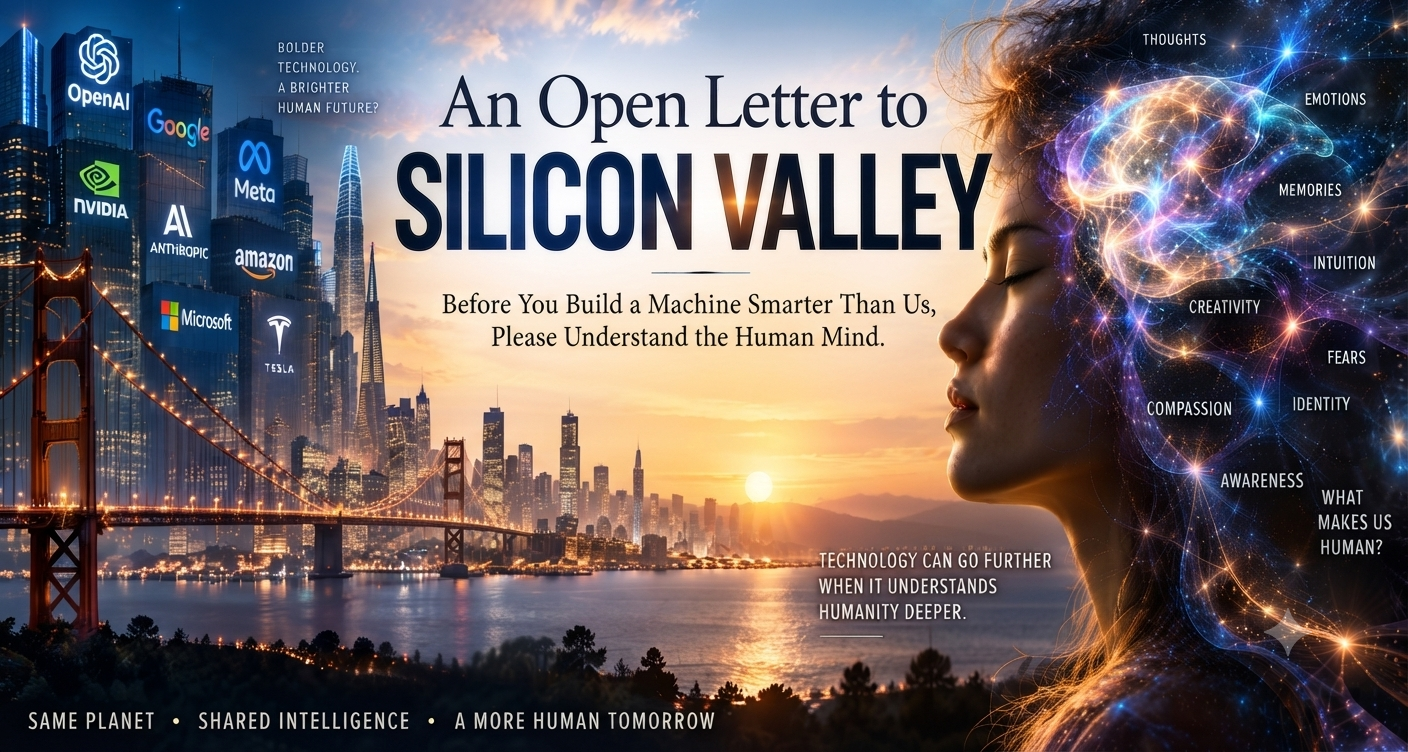
An Open Letter to Silicon Valley
Before You Build a Machine Smarter Than Us, Please Understand the Human Being
Dear Silicon Valley,
I am not a technologist. I don’t understand your codes, chips, neural networks or the billions of calculations happening inside your machines. But I understand something about the human mind. And perhaps right now, that matters just as much.
I have been watching this race towards Artificial Intelligence with fascination, excitement and, increasingly, discomfort. Every few months there is something new: a smarter model, a more powerful agent, more automation, more compute, more billions invested. Everybody seems to be asking the same question: How far can we take AI? I want to ask another one: How far should we take it before we understand ourselves?
Because my fear is not Artificial Intelligence. My fear is artificial intelligence in the hands of an unconscious human being. History has already warned us about this. We have an extraordinary habit as a species: first we discover what we can do, and only afterwards do we begin asking what we should have done.
Think of Oppenheimer and the atomic bomb. Some of the finest scientific minds of their generation discovered how to enter the nucleus of matter itself. What an achievement of human intelligence. And then that intelligence became a weapon capable of destroying cities. The story is more complicated than the popular line that Oppenheimer simply created the bomb and then repented. But he did spend his later years confronting the nuclear danger and opposing the rush towards even more destructive weapons. The lesson remains uncomfortable: intelligence can tell you how to build something. Wisdom has to decide what to do with it.
That distinction matters enormously now. AI is not another washing machine. It is not another television. It may not even be comparable to the internet. We are trying to create systems that could eventually outperform human beings across enormous areas of intelligence. And we are doing it in a race. Company against company. Country against country. Investor against investor. Everybody is afraid that if they slow down, somebody else will get there first.
We have heard that sentence before: If we don’t build it, somebody else will. That is how races begin. And once a race begins, caution starts looking like weakness. Wisdom becomes inconvenient. Nobody wants to be the person asking everyone to slow down while everyone else is running.
I am not against AI. I use it myself. I can see what it can do. It may help us discover medicines, transform education, accelerate science, remove mindless work and solve problems that human beings alone have struggled with for decades. Wonderful. Build it. Explore it. Push boundaries. But please don’t confuse power with progress. They are not the same thing.
A civilisation can become extraordinarily powerful without becoming wise. In fact, that may be the most dangerous civilisation of all.
Look at the human being who is building AI. Has greed disappeared? Has ego disappeared? Has violence disappeared? Has the hunger for domination disappeared? Have nations stopped wanting superiority? Have corporations stopped wanting monopolies? Have human beings stopped manipulating one another? We still fight over land, religion, race, money, ideology and power. The human mind is carrying many of the same ancient problems. Only its tools have changed.
Once we fought with stones. Then swords. Then guns. Then missiles. Then nuclear weapons. Now we are entering the age of intelligent machines. The weapon keeps evolving. Has the mind holding the weapon evolved?
That is what troubles me. Our machines are entering the future while parts of the human mind are still living in the jungle. And the distance between the two is becoming dangerous.
Silicon Valley talks constantly about making AI more intelligent. Who is working with the same urgency on making the human being more conscious? Intelligence and wisdom are not the same thing. A person can be extraordinarily intelligent and deeply unconscious. History is full of brilliant minds serving terrible ideas. A PhD does not remove greed. Genius does not remove ego. Technical brilliance does not automatically produce wisdom.
Intelligence asks: Can we? Wisdom asks: Should we? Modern civilisation has become obsessed with the first question. Our future may depend upon rediscovering the second.
And this is where spirituality enters the AI conversation. Not religion. I am not asking engineers to start going to temples. I mean spirituality in its most basic sense: understanding yourself. Can you see your greed before it controls you? Can you see your ambition, fear, ego and hunger for power? Can you sit silently with your own mind without needing a screen every thirty seconds? Can you hold enormous power without becoming possessed by it?
For thousands of years, people sat under trees, in caves and monasteries asking a question that sounds almost primitive beside a modern AI laboratory: What is this mind? Perhaps we laughed at that question too quickly. Because now this same mind is trying to create another intelligence, while still understanding very little about itself.
We hear a great deal about AI alignment. Maybe before AI alignment, we need human alignment. We want to align machines with human values. Which human values exactly? The values with which we created world wars? Nuclear arsenals? Endless consumption? The values that allow us to speak about mental health while designing technologies to capture every second of human attention? The values that say privacy matters while turning human behaviour into data?
Before teaching a machine our values, perhaps humanity needs to sit down and ask what it actually values. Our words say one thing. Our civilisation often rewards another. We say wellbeing matters, but reward endless growth. We say children matter, then hand them addictive screens before their minds have even developed. We say human connection matters, while building lives in which people can spend entire days interacting with screens and barely touch another human being.
And now we are going to teach machines what it means to be human. Perhaps the machine has every right to be confused.
There is another part of this that should make all of us uncomfortable. So much of this power is concentrating in very few hands. A relatively small number of companies, laboratories, investors and executives are making decisions that may eventually affect how billions of people work, learn, communicate, create, consume information and perhaps even fight wars.
I have enormous respect for the minds building this technology. Many are brilliant. Many genuinely want to improve the world. But brilliance is not immunity from ego. Good intentions are not protection from unintended consequences. And billion-dollar incentives have a strange way of changing philosophical discussions.
Silicon Valley deserves a seat at the table. But Silicon Valley cannot become the table. Humanity cannot simply become the customer of its own future.
There is another word I think we need to examine: more. More compute. More intelligence. More speed. More automation. More data. More productivity. More valuation. More capability. More. More. More. Has anybody in the room got the courage to ask: Enough?
That word has almost disappeared from modern civilisation. We know how to increase. We don’t know when to stop. And a civilisation that cannot understand ‘enough’ eventually becomes a prisoner of ‘more’.
Look at what we have already done to the planet. The problem was never that human beings wanted food, shelter or comfort. The problem was that desire learned no limit. We always wanted more. More land. More wealth. More consumption. More power. Technology did not create that hunger. The human mind did. Now that same mind is building AI. Do you see why the question of consciousness cannot remain outside the technology conversation?
There is also a quieter danger. Maybe AI does not need to become too intelligent for us to have a problem. Maybe we simply become less willing to use our own intelligence. Why remember when AI remembers? Why write when AI writes? Why struggle with a difficult problem when AI solves it? Why read the book when AI can summarise it? Why sit with confusion when an answer arrives in two seconds?
This matters especially for young people. Struggle is not always bad. Confusion is not always bad. Boredom is not always bad. Sometimes the mind grows precisely because nobody gives you the answer. A child who is carried everywhere never develops strong legs. What happens to a generation whose mind is carried everywhere by AI?
Use AI. Learn it. Master it. I would tell every university student to understand this technology deeply. But don’t surrender your mind to it. Read the whole book sometimes. Write the difficult paragraph yourself. Sit with a question. Get bored. Think. Doubt. Make mistakes. There must remain places inside the human being where the machine is not invited.
Silence. Reflection. Original thought. Love. Wonder. Prayer, if you believe in it. The experience of simply being alive. Not everything needs optimisation. Not everything needs automation. Not every question needs an instant answer. Some things need to remain human.
Perhaps AI is not humanity’s greatest test. Perhaps it is simply exposing the test we have been failing for thousands of years: Can human beings handle power without becoming possessed by it? Kings struggled with it. Empires struggled with it. Religions struggled with it. Political systems struggled with it. Corporations struggle with it. Why would technologists automatically be different?
Power does something very strange to the human mind. And AI is power – enormous power. That is why the people building it need something more than technical education. They need history. Philosophy. Psychology. Ethics. Art. And yes, some understanding of consciousness. Not because spirituality has the technical answers to AI. It doesn’t. But because it has been asking questions about the human mind that technology desperately needs to hear.
Who am I? What is greed? What is fear? What is enough? Why do I want power? Why do I need to dominate? What happens when desire has no limit? These questions may be ancient. I think they are becoming technologically urgent.
So this is my request to Silicon Valley: please build the future. But don’t become so intoxicated with building it that you forget to ask what kind of future you are building. Don’t wait for another Oppenheimer moment. Don’t create first and become philosophical afterwards.
Bring philosophers into the room now. Bring psychologists, teachers, parents, historians, artists, spiritual thinkers and young people. Bring people who may not understand your code but understand parts of life your code cannot measure. The future of humanity is too important to be left only to people who understand machines. And it is certainly too important to be left only to markets.
I don’t want less AI. I want a wiser humanity standing beside it. I want technology that helps human beings become more human, not less. Technology that gives us time rather than consuming our attention. Technology that expands intelligence without shrinking independent thought. Technology that heals rather than manipulates. Technology that serves life rather than slowly making life serve technology.
Maybe this sounds idealistic. But what is the alternative? Keep racing? Keep scaling? Keep building? And hope wisdom somehow arrives later? History tells us that ‘later’ can be very expensive.
Before you build a machine smarter than humanity, please ask one simple question: Is humanity becoming wise enough to live with it?
Because the greatest danger may not be that Artificial Intelligence develops a mind of its own. The greater danger may be that it becomes an extension of ours – our greed, our fear, our ambition, our need for control – but with infinitely more power.
Perhaps the future will not finally be decided by how intelligent our machines became. It will be decided by whether the human being holding that intelligence learned one ancient lesson: power without consciousness is dangerous.
We have spent centuries upgrading our machines. Maybe it is time we upgraded the human being. Not with another chip. Not with another algorithm. By finally understanding the one technology we have neglected all along: our own mind.