
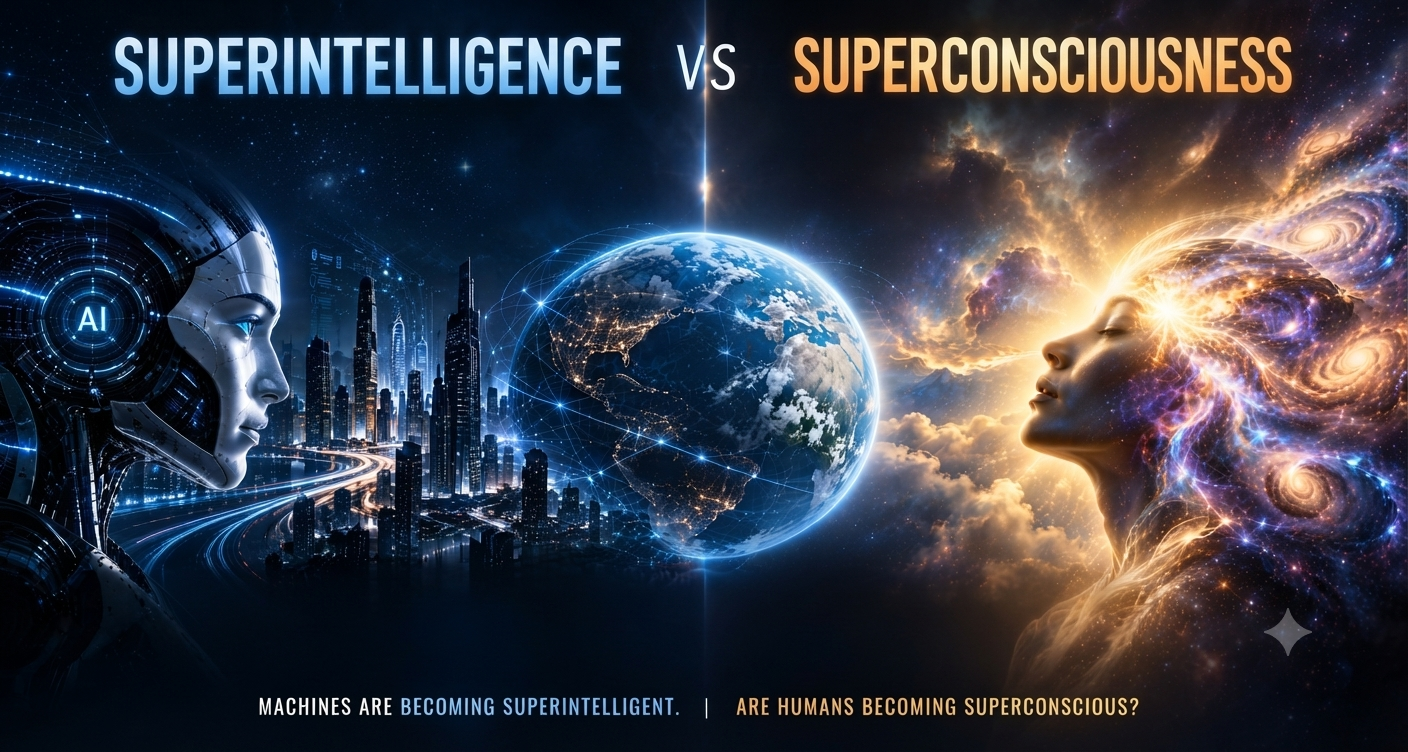
SUPERINTELLIGENCE vs SUPERCONSCIOUSNESS
A White Paper on the Race Humanity Cannot Afford to Lose
A civilisational inquiry into artificial intelligence, human redundancy, consciousness and the future of power
Something very serious is happening in Silicon Valley, and I am not sure we are treating it with the seriousness it deserves. Artificial Intelligence is no longer moving like another technology cycle. It is beginning to move like a force capable of reorganising civilisation itself. The 2026 Stanford AI Index reports that AI capability continues to accelerate across several demanding benchmarks, while industry now produces the overwhelming majority of notable frontier models. Adoption inside organisations has also moved from experimentation toward normal business infrastructure. None of this proves that human-level general intelligence has arrived, but it does tell us that the direction of travel is no longer theoretical.
We should be excited by what this could mean. AI could help scientists discover medicines faster, improve education, accelerate research, remove dangerous and repetitive work, expand human creativity and perhaps solve problems that have defeated us for generations. I am not interested in another fashionable argument that technology is evil. Technology has never been the real problem. The human being holding the technology is the problem. That is exactly why the people building frontier AI need to ask themselves a question far more uncomfortable than how many parameters the next model should have or who will win the race to AGI: Who are you building this for?
For yourself? For your company? For your investors? For valuation? For national supremacy? For the thrill of being first? Or genuinely for humanity? There is nothing wrong with ambition. There is nothing wrong with building great companies or becoming wealthy. But if the answer is that this is being built for humanity, then humanity cannot simply become the experimental subject of that ambition. You cannot say you are building the future for eight billion people while asking those same eight billion people to carry risks they never agreed to take.
That question becomes even harder when some of the people closest to frontier AI are themselves discussing the need to pace capability, strengthen independent evaluation and give institutions more time to catch up. When people sitting closest to the machine begin asking whether the machine is moving too quickly, the rest of us should pay attention. Not panic. Pay attention. The point is not that AI must stop. The point is that even the builders are acknowledging that capability can move faster than governance, safety and social adaptation.
Humanity has seen this pattern before. Oppenheimer and the scientists of the Manhattan Project helped unlock one of the most powerful forces nature had hidden from us. The bomb came first; the terrible questions of control, proliferation and consequence became unavoidable afterwards. Oppenheimer later opposed a crash programme for the hydrogen bomb. AI is not an atomic bomb, and lazy comparisons help nobody. But one lesson remains: there is very little comfort in discovering wisdom after irreversible power has already escaped the laboratory. There is no point regretting after Frankenstein is out.
This is why the current AI debate is still too small. We keep discussing model safety, regulation, bias, hallucinations, cyber risk and employment. All of these matter. But beneath them is a much bigger possibility: we may be developing a technology capable of disturbing several foundations of civilisation at the same time. To understand that, we first have to remember how civilisation actually works.
Civilisation is not an abstract thing made of skyscrapers, governments and constitutions. It is an enormous web of human participation. Billions of people wake up every morning and do something another human being needs. Someone grows food. Someone builds houses. Someone teaches children. Someone manufactures medicine. Someone drives a truck. Someone writes software. Someone treats patients. Someone runs a restaurant. Someone repairs a machine. Someone creates music. Someone manages accounts. Someone cleans an office. Someone starts a company. In return for participating, people receive income. They then use that income to participate again, this time as consumers.
They buy food, housing, clothes, transport, healthcare, education and entertainment. Businesses earn because people spend. Governments collect taxes because people and companies earn. Families survive because income circulates. Savings become investment. Investment creates businesses. Businesses employ people. People consume what businesses produce. The system is imperfect, often deeply unfair, but human participation still sits near its centre.
Technology has always disrupted this arrangement. The tractor reduced the need for agricultural labour. Factories replaced many forms of manual work. Computers eliminated armies of clerical jobs. The internet destroyed some businesses and created others. Humanity adapted and new work appeared. That historical experience is one reason we should be careful with dramatic predictions that AI will simply make everybody unemployed. We do not know that. The International Labour Organization has similarly cautioned that generative AI is more likely, at least in the near term, to transform many occupations than erase them completely.
But there is something different about the current possibility. Previous machines usually automated a particular class of physical or cognitive tasks. Advanced AI is potentially general across thousands of different cognitive activities, while robotics may increasingly extend automation into the physical world. The same broad technology could therefore move across professions and sectors with a reach previous machines did not possess. We do not know how far this will go, but if the long-term promise of AI is serious, we have to follow the logic beyond the next quarterly earnings call.
Imagine a system in which AI designs a product, robots manufacture it, autonomous systems transport it, algorithms advertise it, AI agents negotiate the sale, software handles accounting, inventory, compliance and customer service, and other machines maintain the machines. A handful of humans supervise a system that once required thousands. From the point of view of efficiency, this looks magnificent. From the point of view of civilisation, one irritating question remains: Who has the money to buy what the machines are producing?
A machine does not demand a salary. Wonderful for costs. But the machine also does not buy shoes. It does not take its family to dinner. It does not pay school fees. It does not dream about buying a house. It does not save for retirement. It does not go on holiday because it is exhausted. It does not suddenly decide it wants a better car. Human beings do these things. The worker corporations are trying so hard to remove from the cost side of the ledger is often the same human being corporations need on the revenue side as a customer.
This is why extreme automation, if it arrives, will not simply be a jobs problem. It could become a structural economic problem. The IMF has estimated that almost 40 percent of global employment is exposed to AI, rising to around 60 percent in advanced economies. Exposure does not mean disappearance; in many jobs AI will complement workers rather than replace them. But if machines become responsible for a steadily larger proportion of wealth creation, while employment remains the main way ordinary people obtain purchasing power, something has to give.
Perhaps ownership becomes more widely distributed. Perhaps universal basic income emerges. Perhaps societies create social dividends from automated production. Perhaps taxes on capital replace more taxes on labour. Perhaps working weeks shrink radically. Perhaps entirely new kinds of work appear. All are possible. But none is a minor adjustment. They require us to reconsider one of civilisation’s oldest arrangements: the relationship between work, income and the right to participate in economic life.
And beneath the economic question is something even more difficult. For centuries we have trained people to identify themselves through work. Ask somebody, “What are you?” and they reply, “I am a doctor. I am an engineer. I am a teacher. I am a lawyer.” Notice how strange that is. We ask who they are, and they tell us how they earn. Work has not merely been an economic activity. It has given human beings structure, identity, discipline, community, competence, status and, for many, purpose.
What happens if a civilisation gradually needs far less human work? Silicon Valley often treats that possibility as liberation. Maybe it will be. Perhaps human beings will finally be freed from repetitive labour and have time for family, creativity, learning and exploration. I hope so. But freedom from work does not automatically create meaning. A person can have unlimited leisure and still have no idea what to do with his life. In fact, AI may confront humanity with one of the oldest questions we have avoided by staying busy: if I no longer have to spend most of my life earning a living, what exactly am I living for?
That is not a technological question and it is not an economic question. It is an existential question. Now add another revolution happening alongside automation. We are not only beginning to outsource work. We are beginning to outsource thinking. Need an email? AI writes it. Need research? AI finds it. Need a presentation? AI prepares it. Need code? AI produces it. Need a summary of the book you never read? AI gives it to you. Need an argument? AI constructs it. Need an answer to the problem you might once have struggled with for three days? It appears in three seconds.
Again, this is extraordinary. I use AI myself. I see its possibilities. But there is a question we should not be afraid to ask just because it makes the technology less convenient: what happens to the human mind when it is no longer required to struggle? There is a generation alive today that grew up before generative AI. We had to read, remember, search, calculate, sit with confusion, get things wrong, argue with ourselves, ask other people and try again. Another generation is beginning life with an intelligent assistant permanently available.
They may become much more capable than us. They may learn faster, build faster and create faster. But efficiency is not necessarily thinking. Perhaps twenty-five years from now we should conduct a very simple experiment: take the AI away. Which generation can still think independently? We do not know the answer. That uncertainty itself should concern us. A child carried everywhere gets to the destination faster, but the legs do not become stronger. What happens when the mind is carried everywhere?
We may therefore be approaching a strange civilisational possibility: machines become increasingly necessary while human beings become increasingly economically redundant and cognitively dependent. Think about that combination. A civilisation that does not need many people to work and gradually teaches them not to think. What exactly have we created then? This is where the question becomes bigger than AI safety. It becomes a question about the human being.
And it is here that Silicon Valley’s obsession with intelligence begins to reveal its limitation. We have become fascinated with how intelligent machines can become: more compute, more data, better reasoning, better agents, better benchmarks, bigger infrastructure, more capability. But intelligence is not wisdom. Human history should have settled that argument by now. Intelligence discovers nuclear physics; intelligence also builds nuclear weapons. Intelligence discovers chemistry; intelligence also builds chemical weapons. Intelligence creates social media; intelligence also discovers how efficiently human psychology can be manipulated for attention and profit.
Intelligence creates power. It does not tell us what to do with power. That distinction may become the most important distinction of the AI century. And this is where another word has to enter the conversation: consciousness. We are trying to create Superintelligence while we still do not have a settled scientific explanation of consciousness. Philosophers, neuroscientists and computer scientists continue debating what subjective experience is, how it arises, and whether intelligence requires it at all. That should humble us.
We are trying to build something “beyond” human intelligence without fully understanding the field in which human intelligence appears. I will not make the pseudo-scientific claim that modern neuroscience has proved intelligence comes from consciousness. It has not. But Indian philosophy has spent thousands of years making a different proposition: mind, intellect and consciousness should not simply be collapsed into one thing. Across different schools, using different vocabularies and metaphysics, there is a recurring attempt to distinguish mental activity from the awareness in which mental activity is known. That becomes very interesting in the age of AI.
The Inner Architecture We Forgot to Study
The Katha Upanishad gives one of the clearest images. It compares the body to a chariot, the senses to horses, the mind to the reins, the intellect to the driver and the Self to the lord of the chariot. You do not have to accept its metaphysics to understand the power of the metaphor. Silicon Valley is building an unbelievable chariot. The horses are becoming extraordinarily powerful, the reins are becoming more sophisticated, and the driver may soon process information on a scale no individual human being can approach. But the Upanishad leaves us with a question that does not appear on any benchmark: who is riding the chariot? We are spending billions improving the vehicle. What do we know about the being deciding where it goes?
Katha Upanishad 1.3.3–1.3.4, English rendering: “Know the Self as the master of the chariot, the body as the chariot; know the intellect as the charioteer and the mind as the reins. The senses are said to be the horses, and the objects of the senses their roads.”
The Kena Upanishad pushes the inquiry even deeper. It begins not by asking how to think more, but by asking what directs the mind itself, what stands behind speech, sight and hearing. Its famous expression, “the mind of the mind,” is not a technological answer and should never be misrepresented as one. It is a philosophical challenge to our assumption that cognition is the final layer of the mystery. Modern AI asks how powerful cognition can become. The Kena asks what it is by which cognition itself is known. Those are not the same question.
Kena Upanishad 1.1–1.2, English rendering: “By whose will does the mind go toward its object? At whose command does life-breath move? … It is the ear of the ear, the mind of the mind, the speech of speech, the life of life and the eye of the eye.”
Science should investigate these questions scientifically. Scripture does not get to end that debate. But scripture has every right to remind us that the debate exists. The Bhagavad Gita then turns the problem from metaphysics toward psychology. In Chapter 6, Krishna speaks of the self or mind as capable of functioning as either friend or enemy depending on discipline. The Sanskrit word atman carries interpretive complexity, so it should not be reduced to a motivational slogan. Yet the practical insight remains sharp: an inner instrument that is not governed can turn against the person using it.
Bhagavad Gita 6.5–6.6, English rendering: “One should raise oneself by oneself and not allow oneself to fall; for the self alone is one’s friend, and the self alone is one’s enemy. For one who has mastered oneself, the self is a friend; for one who has not, it behaves as an enemy.”
Now place that idea inside the age of Superintelligence. What happens when a mind we have not mastered receives an intelligence more powerful than anything it has ever possessed? Greed does not disappear; greed becomes more capable. Ego does not disappear; ego gets scale. Political manipulation does not disappear; it becomes personalised. Hatred does not disappear; it gains better tools. Military ambition does not disappear; it gains faster analysis. The hunger for domination does not disappear merely because the machine is cleverer. Human history gives us no reason to believe it will.
This is why so much of the conventional AI-risk conversation feels incomplete. We are obsessed with whether the machine will develop dangerous intentions while saying far less about the dangerous intentions human beings already have. AI does not need to hate us to become dangerous. It only needs to become powerful enough in the hands of people who hate each other. It does not need greed; the market can supply that. It does not need ego; we have enough. It does not need a desire for power; politics, corporations and nations have carried that desire for thousands of years. Perhaps the real alignment problem is not only aligning AI with humanity. It is aligning humanity with the power AI is giving us.
Patanjali’s Yoga Sutras go somewhere even more radical. The famous definition yogaś citta-vṛtti-nirodhaḥ points, in broad terms, toward the stilling or restraint of the movements of citta. The next sutra says that then the seer abides in its own nature. Think about the contrast. We may be building the greatest machine for generating mental content humanity has ever known: endless language, images, analysis, answers and stimulation. Yoga asks what happens when the movement becomes still.
Patanjali Yoga Sutras 1.2–1.3, English rendering: “Yoga is the stilling of the modifications of the mind. Then the Seer abides in its own true nature.”
Modern civilisation has become brilliant at addition. Yoga investigated subtraction. We know how to accelerate. Yoga asks what happens when you stop. We know how to produce more thought. Yoga asks whether the human being is merely thought. That is not an attack on intelligence. It is an inquiry into whether intelligence is the highest possibility of consciousness.
Why the Yoga Vasistha Belongs in the AI Conversation
If I were an AI founder sitting in Silicon Valley today, I would seriously read the Yoga Vasistha. Not because it contains AI. It does not. Not because Vasistha secretly predicted neural networks. He did not. I would read it because it spends an extraordinary amount of intellectual energy investigating the relationship between mind, perception, desire, experience and consciousness. The text is structured as a dialogue between Vasistha and Rama, and one of its recurring themes is that the mind profoundly conditions the world as we experience it.
Yoga Vasistha Sara, Chapter 4, verses 8–10, English rendering: “The mind is the creator of the world; the mind is the individual. The mind is the cause of the objects of perception. The mind is bound by latent impressions; when there are no impressions it is free.”
The point is not to turn an ancient spiritual text into cognitive science. The point is the direction of inquiry. Rama’s crisis begins despite privilege. He has status, comfort and the external possibilities of life in front of him, yet something in him refuses to be satisfied by the obvious answers. Vasistha does not tell him to acquire more. He turns the inquiry toward the mind experiencing all of it. That question may become brutally relevant if AI succeeds.
Suppose Silicon Valley gives humanity more productivity, more leisure, more convenience, more knowledge, more entertainment and eventually far more material abundance. Then what? What if a human being has everything externally and remains anxious internally? What if the world becomes easier but the mind remains restless? What if machines solve labour but cannot solve loneliness? What if information becomes infinite and meaning becomes scarce? What if desire simply keeps moving the goalpost? What if civilisation discovers that the biggest unsolved problem was never the shortage of things, but the inability of the mind to know when enough was enough?
There is a very Silicon Valley belief hidden inside much of our technological culture: if something is not working, add capability. More processing. More optimisation. More scale. More productivity. More information. The Yoga Vasistha keeps returning us to another possibility. Perhaps sometimes the problem is not that the human being has too little. Perhaps the mind itself does not understand what it is seeking. No amount of computation can answer that on our behalf.
Yoga Vasistha Sara, Chapter 9, verses 31–32, English rendering: “There is only consciousness here; this universe is nothing but consciousness; you are consciousness, I am consciousness, the worlds are consciousness. Consciousness alone shines by itself.”
This brings us toward what I mean by Superconsciousness. I use the word carefully because it is not one standard Sanskrit term used uniformly across Indian traditions. The Upanishads, Yoga, Vedanta, Kashmir Shaivism and the Yoga Vasistha do not all mean exactly the same thing by Self, consciousness, liberation, samadhi, turiya or awareness. We should not flatten thousands of years of philosophy into one convenient modern word. But there is a common direction worth noticing: these traditions refused to assume that ordinary, restless, compulsive human cognition is the final possibility of the human being.
They investigated whether attention could become clearer, whether desire could be understood rather than obeyed, whether fear could be observed, whether thought could be witnessed, whether awareness could exist without constant identification with every movement of mind, and whether consciousness could know itself more deeply. That is the territory I am calling Superconsciousness: not supernatural power, not magic, not another religion, but the development of the human being inwardly so that greater external power is matched by greater awareness of the mind using that power.
The Shiva Sutras open with perhaps the most uncompromising formulation of all: caitanyam atma — consciousness is the Self. Kashmir Shaivism is making a metaphysical claim here, not a neuroscience claim, and that distinction must remain clear. But as a philosophical position, it turns the AI conversation upside down. Silicon Valley is asking how intelligent a machine can become. The Shiva Sutras begin by placing consciousness itself at the heart of being. One inquiry asks about capability. The other asks about existence. One asks how much can be processed. The other asks who is aware. Why should those two conversations remain separated?
Shiva Sutras 1.1, English rendering: “Consciousness is the Self.”
The Real Alignment Problem
I do not want spirituality to replace science. That would be regression. And I do not want science pretending consciousness is irrelevant simply because it is difficult to measure. That would be arrogance. Perhaps the future requires both inquiries to become serious at the same time. This is why I do not ultimately see Superintelligence and Superconsciousness as enemies. I see them as two races whose speeds have become dangerously unequal.
Superintelligence is moving like a rocket. Superconsciousness is barely part of the public conversation. One is receiving hundreds of billions of dollars, the best mathematical talent, massive data centres, government attention, semiconductor supply chains and geopolitical urgency. The other is still treated as something belonging to monasteries, meditation centres or religious people. That imbalance may become dangerous.
Imagine Superintelligence in the hands of a deeply conscious civilisation. AI could accelerate medicine, help us understand climate systems, improve education, reduce drudgery, expand accessibility, discover new science and give people extraordinary creative power. Now imagine the same Superintelligence in a civilisation driven by greed, fear, tribalism, military rivalry, compulsive consumption and hunger for domination. Same intelligence. Different consciousness. Completely different future.
This is why consciousness remains the more fundamental civilisational question. Not because intelligence is unimportant, but because intelligence is power and power always serves the consciousness holding it. Give enormous intelligence to compassion and compassion becomes more capable. Give it to medicine and medicine becomes more capable. Give it to greed and greed becomes more capable. Give it to authoritarianism and authoritarianism becomes more capable. Give it to war and war becomes more capable. AI may therefore be neither humanity’s saviour nor its destroyer. It may be the greatest amplifier we have ever built, and what it amplifies will depend enormously on us.
This brings me back to the founders. If you genuinely believe you are building AI for humanity, then perhaps the responsibility is larger than making the model safe enough to ship. You have to ask what kind of civilisation you are creating around it. What happens to labour? What happens to ownership? What happens to children who grow up outsourcing thought? What happens to inequality when intelligence becomes capital? What happens to democracy when persuasion becomes automated? What happens to truth when synthetic information becomes infinite? What happens to human purpose when economic usefulness declines? And perhaps the most uncomfortable question of all: what happens when human power becomes almost godlike while human consciousness remains psychologically primitive?
Those questions cannot be delegated to engineers after deployment, and they cannot be solved by engineers alone. The room has to become bigger. Philosophers belong there. Psychologists belong there. Historians belong there. Economists belong there. Educators belong there. People who study power belong there. People who study the mind belong there. And yes, humanity’s contemplative traditions belong somewhere in that conversation too — not as authorities that science must obey, but as repositories of serious inquiry into dimensions of the human being our technological civilisation has often neglected.
We keep talking about AI alignment. Perhaps it is time to talk about human alignment. Aligned with what? Enough instead of endless more. Wisdom instead of capability alone. Awareness instead of compulsion. Human dignity beyond economic usefulness. Technology in service of life rather than life reorganised permanently around technology. Maybe that sounds philosophical. It is. Civilisation itself is built upon philosophy whether its engineers admit it or not. Every system contains an idea of what a human being is and what human life is for.
Our current system often answers that question silently: the human being is a worker, a consumer, a data point and a user. AI may force us to decide whether that was ever enough. Perhaps that is the hidden gift inside this crisis. If machines become better than us at calculation, memory, analysis and many forms of work, humanity may finally be forced to stop defining itself through calculation, memory, analysis and work. We may have to ask what remains: consciousness, relationship, love, creativity, awareness, wonder, meaning, and the ability to experience existence rather than merely optimise it.
That may sound less impressive than Superintelligence to someone raising a new funding round, but I suspect it is the bigger frontier. Building intelligence outside ourselves is fundamentally an engineering problem. Understanding consciousness within ourselves is a human problem. We have been postponing it for thousands of years. We still have an opportunity to ask better questions before the architecture of the future becomes irreversible.
I am not asking Silicon Valley to stop creating Superintelligence. Create it. But do not worship it. Do not mistake intelligence for wisdom. Do not mistake capability for progress. Do not mistake automation for civilisation. Do not mistake convenience for human development. And please do not tell humanity this is all being built for us unless you are willing to place humanity’s long-term wellbeing above the race itself. Because if this truly is for humanity, then humanity cannot be collateral damage.
The future does not need less intelligence. It needs intelligence held by deeper consciousness. That is why the great race of the twenty-first century may not be America versus China. It may not be OpenAI versus Anthropic, Google versus xAI, or humans versus machines. The real race may be far more fundamental: the race between our growing power and our growing consciousness. Right now, power is winning by a frightening margin.
If that gap becomes too large, Superintelligence may not destroy us because it became something alien. It may destroy what we value because it became an unbelievably powerful extension of what is still primitive within us. The Upanishads asked what stands behind the mind. Krishna asked whether we had mastered the mind. Patanjali investigated what remains when the movement of mind becomes still. The Yoga Vasistha examined the mind that constructs and suffers its world. The Shiva Sutras began with the assertion that consciousness itself is the Self. Different texts, different philosophies, different centuries — yet all turned human attention toward a territory we are strangely neglecting at precisely the moment we are preparing to multiply intelligence beyond anything previously imaginable.
Perhaps that is the conversation Silicon Valley now needs. Not less science, but deeper science. Not religion replacing technology, but consciousness entering the discussion about what technology is for. Not ancient scripture pretending to know the future, but ancient inquiry reminding the future that the human being remains unfinished. Machines may eventually reason beyond us. They may know more than us. They may discover what we cannot discover. Let them. Intelligence was never the whole mystery.
The deeper question has always remained underneath it: who is aware, who chooses, who desires, who fears, who uses the power, and what kind of consciousness stands behind the intelligence? Superintelligence may change civilisation. Superconsciousness changes the being creating civilisation. We need both, but they are not equal in their role. Intelligence is an instrument. Consciousness decides what the instrument becomes.
Power can become superhuman. Intelligence can become superhuman. Machines may become superhuman. But unless humanity learns to understand the mind holding all that power, we will simply become the same old human being with an infinitely more dangerous toolbox. That is why, after all the algorithms, all the models, all the data centres, all the investment, all the competition and all the excitement, I return to one conclusion: Consciousness remains supreme.
Selected References
Stanford Institute for Human-Centered Artificial Intelligence. The AI Index Report 2026.
International Monetary Fund. “Gen-AI: Artificial Intelligence and the Future of Work,” 2024.
International Labour Organization. Generative AI and Jobs: A Refined Global Index of Occupational Exposure, 2025.
Katha Upanishad, 1.3.3–1.3.4.
Kena Upanishad, 1.1–1.2.
Bhagavad Gita, 6.5–6.6.
Patanjali Yoga Sutras, 1.2–1.3.
Yoga Vasistha Sara, Chapter 4, verses 8–10; Chapter 9, verses 31–32.
Shiva Sutras, 1.1.