
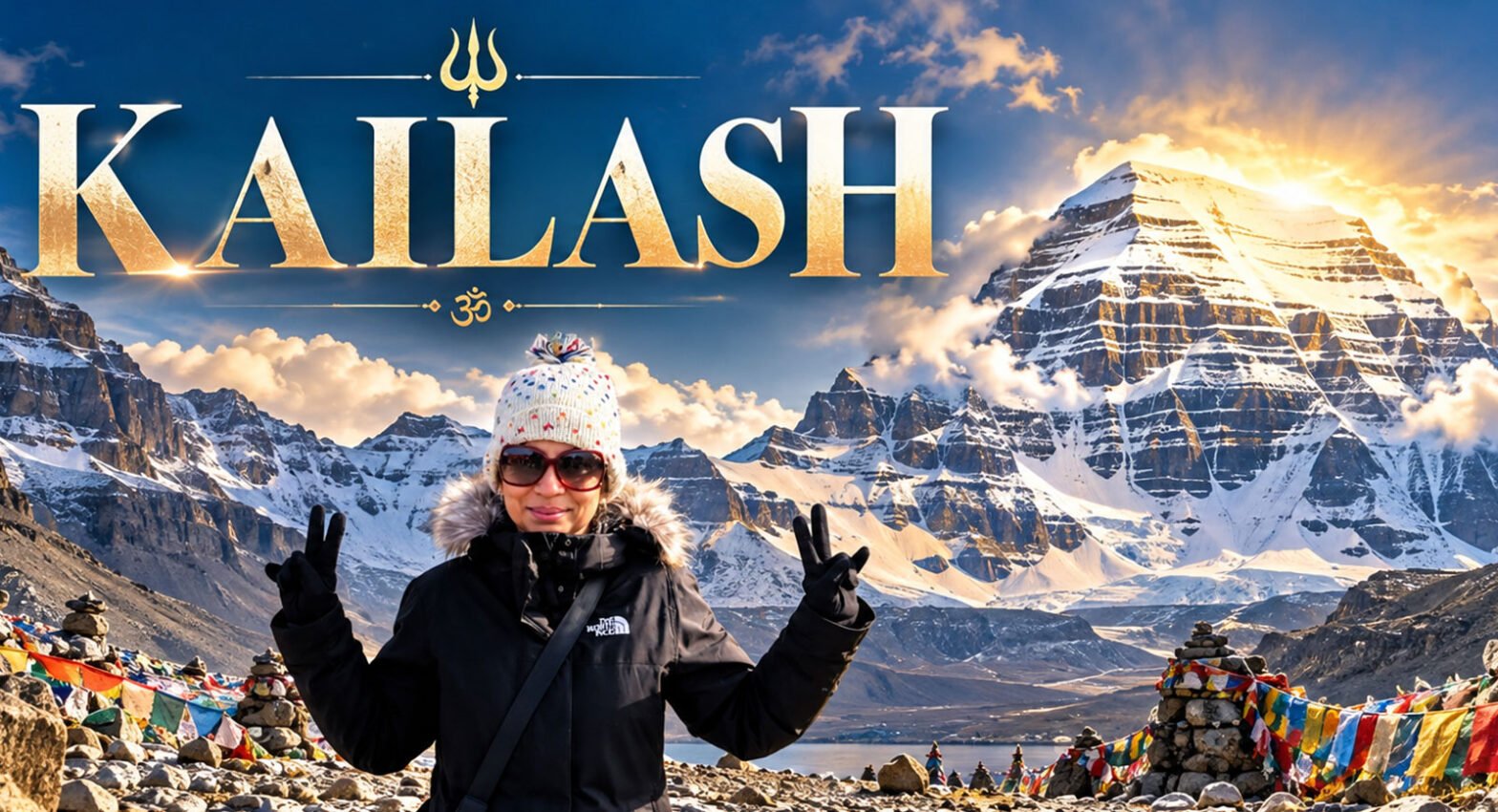
Kailash Destroyed Me — And I Am Grateful
A personal journey from identity to something beyond it
My journey to Kailash did not begin when I first reached there in 2019. It began when I was around five years old. I did not know where Kailash was. I did not know its geography, its history, or its spiritual significance. I knew nothing about the difficult journey people take to reach it. But somewhere inside me there was a strange pull towards Kailash, and an equally strange certainty that one day I would reach there. I cannot explain where that feeling came from. At five, you do not have the language to explain these things. You simply know what you know.
Years passed. Life happened. I grew up, took on all the identities life gives us, and became busy with the world like everyone else. But Kailash remained somewhere inside me. Then, in 2019, after carrying that inexplicable longing for decades, I finally stood before it. The five-year-old child in me had reached the mountain she had somehow always known she would reach.
I wish I could say that I understood immediately what had happened to me there. I did not. Some experiences are too large to understand while you are inside them. You understand them only by watching what they slowly do to your life. I returned from Kailash, but something in me did not return in the same way. The person who had gone there began to change, and over the years that change became so deep that today, when I look at the woman who first went to Kailash in 2019, she sometimes feels like another person.
In the last seven years, by Shiva’s grace, I have been blessed to make this journey three times. I often say that Shiva has witnessed me three times. I do not say this as a claim of spiritual achievement. Quite the opposite. Every journey has made me feel smaller before something I cannot fully understand, and every journey has taken something away from me that I once thought was essential to who I was.
People often speak about spiritual journeys as if they add something to you. Wisdom. Peace. Knowledge. Some special identity. My experience of Kailash has been almost the opposite. Kailash did not add to me. Kailash started removing me.
It removed certainties. It removed labels. It removed many beliefs I had inherited without ever examining them. It removed my need to fit neatly into identities. It removed illusions I had about life, spirituality, religion and even about myself. None of this happened because I made a list and decided to become detached. There was no great effort from my side. Things simply started falling away on their own.
That is why I sometimes say something that may sound strange: Kailash destroyed me, and I am grateful for that destruction. Shiva, in our tradition, is called the destroyer, but perhaps we misunderstand destruction when we think it only means an ending. Sometimes destruction is grace. Sometimes what needs to be destroyed is not your life, but everything false that you have mistaken for your life. An identity can become a prison. A belief can become a wall. An illusion can feel like truth simply because we have carried it for a long time. When those things begin to break, it can feel like destruction. But perhaps something more real finally gets space to breathe.
Kailash gave me something too. It gave me a purpose and a direction to my life. Not a purpose imposed by society, not a title, not a role I had to perform, but a quiet sense that my life had to become larger than my own small concerns. I began to feel that whatever years I have been given should be used to inquire, to understand, to serve, and to speak about the questions that matter to human beings. I do not claim to have the answers. In fact, Kailash has made me more comfortable with not having them.
Perhaps the deepest change has been in how I understand identity. I was born in India. My body has an Indian identity. Hinduism is the religious and cultural identity into which this body was born. I respect that, and I do not feel the need to run away from it. But somewhere along this journey I realised that while my body has an identity, my soul does not.
My soul has no nationality. It has no race. It has no religion. It has no passport. It does not become more sacred because I call it Hindu, nor less sacred because another human being gives it another name. The labels belong to this life and to the world we have created around ourselves. They help us organise societies, histories and communities. But I no longer feel they describe the deepest part of who I am.
For me, that deepest part belongs to Kailash. And even when I say that, I know Kailash itself may be pointing me towards something far bigger than a mountain, a place or a religious symbol. It points me towards something universal, something for which I still do not have adequate words. Shiva, to me, has slowly become less of an identity and more of a vastness in which identities disappear.
This also changed my relationship with religion. I did not become anti-religion. I simply began to see the difference between God and the structures human beings build around God. Religion can be a beautiful doorway, but a doorway is not the sky. Culture can give us roots, but roots are not meant to become chains. Scriptures can point towards truth, but the moment we stop inquiring and begin blindly defending the pointer, perhaps we have missed what it was pointing towards.
The strange thing is that losing labels has not made me love India less or reject Hinduism. It has simply made my idea of belonging much larger. I can belong to India and still feel that the whole earth is home. I can be born into Hinduism and still recognise something sacred in a human being who has never heard the word Hindu. I can bow before Shiva without needing another person to bow before the same name.
Since these journeys, I have increasingly started living with a simple feeling: this Universe is my home. Human beings, of course, have created borders, passports, visas and nations, and I live within those realities like everyone else. I understand why societies need boundaries and systems. But inwardly, the borders have become much weaker. When I look at another human being, I find it increasingly difficult to believe that the lines drawn on maps describe what we ultimately are.
Maybe this is what Kailash has been doing to me since I was five years old. Maybe the longing was never only about reaching a geographical place. Maybe something in me was longing to reach a point where the identities I would collect through life could finally begin to fall away.
Three journeys later, I cannot say I understand Kailash. I would be suspicious of myself if I ever made such a claim. Kailash remains bigger than anything I can say about it. I only know what it has done to me.
It gave me direction, but took away many of my maps. It gave me purpose, but took away identities I once thought defined me. It brought me closer to Shiva, but at the same time made Shiva impossible for me to contain inside one label, one religion or one idea.
And perhaps that is why I still long for Kailash. Not because I want another spiritual experience to add to my collection, but because every time I have gone there, I have returned carrying a little less of what I am not.
If you ask me today who I am, the worldly answer is still easy. I have a name, a nationality, a religion, a history and a body that belongs to a particular place and time. But beneath all of that, there is another answer slowly becoming clearer.
My body has an identity. My soul has none.
And somehow, after three journeys to Kailash, that no longer feels like losing who I am. It feels like coming home.