
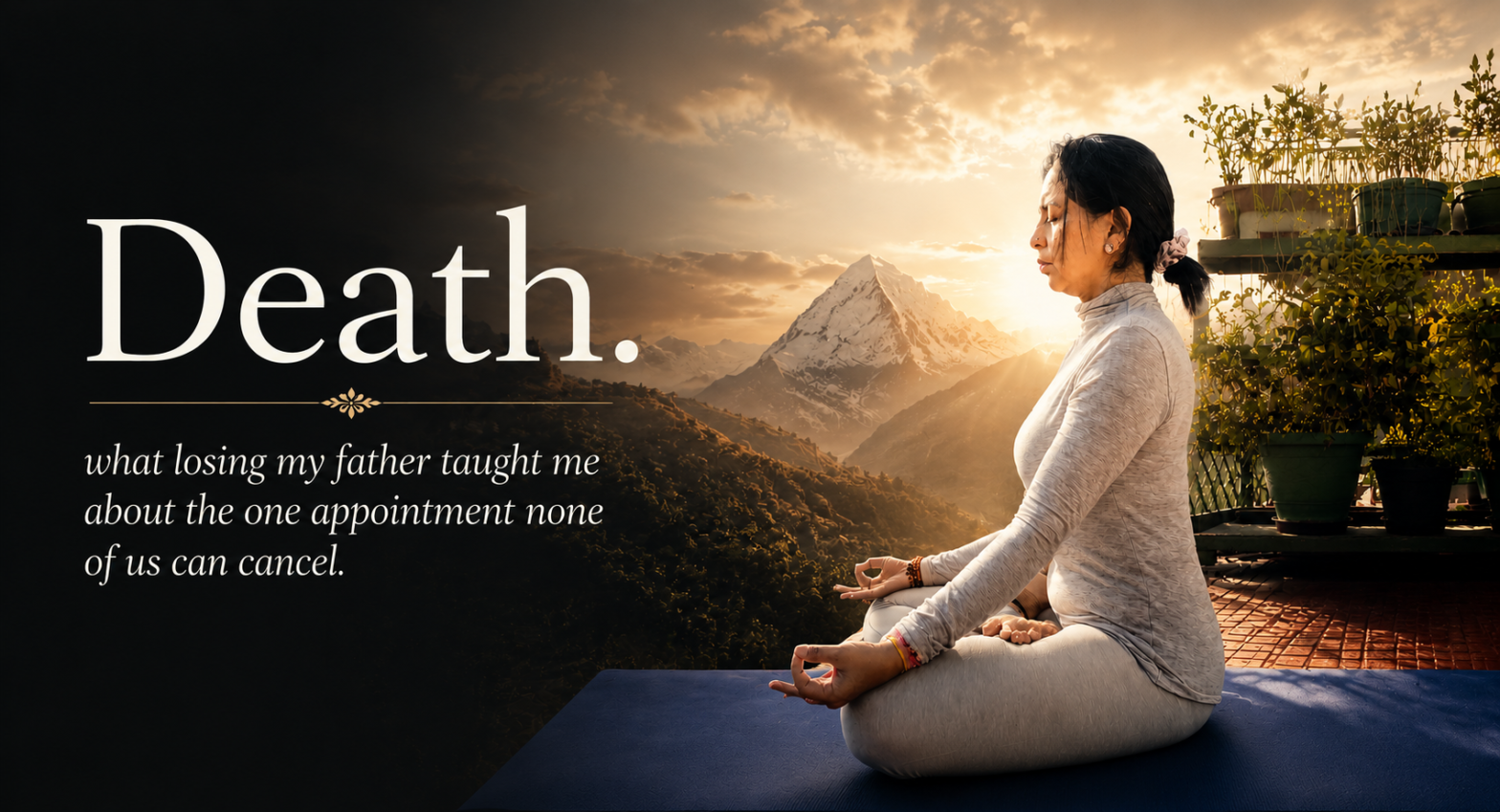
DEATH.
THE ONLY TRUTH NOBODY WANTS TO FACE.
What losing my father taught me about the one appointment none of us can cancel.
We are all chasing something. Money, status, power, relationships, wealth, recognition, security, the next goal, the next milestone, the next thing that will finally make us feel that we have arrived somewhere worth arriving. We spend our entire lives in this chase, breathless and relentless, convinced that whatever we are running toward is the most important thing in the world.
And while we chase, something chases us- silently, patiently, without urgency. Because it knows something we spend our entire lives refusing to accept, that it will catch us, every single time, without a single exception in the entire history of the human race.
Death does not chase you the way you chase your goals. It does not rush. It does not panic. It simply moves at its own pace toward its own appointment with you, an appointment that was made the moment you arrived. And yet we live as if that appointment is not in the calendar.
The Call That Changes Everything.
My father called me that morning and he was watching television, his voice completely normal, nothing in that conversation that said goodbye, nothing that said remember this, nothing that said this is the last time you will hear me speak.
A few hours later, my mother called. He was gone. 79 years old, a heart attack, three to four minutes, gone before he could have known what was happening. That phone call at 8 pm did not just tell me my father had left. It dismantled every illusion I had carefully constructed about time, about later, about the visits I would make and the conversations I would have and the questions I would ask him about his life, his journey, his pain, his wisdom, all the things I kept saving for a time that no longer exists.
Years of Yoga, years of studying the scriptures, years of sitting with the deepest philosophical truths about impermanence and the nature of existence, and nothing, not one word of scripture, not one hour of meditation, prepared me for carrying my father’s ashes in my lap, feeling what was once a living, breathing, laughing, deeply godly man reduced to ashes and bones.
The Mundaka Upanishad says: as rivers flowing into the ocean find their final peace and lose their name and form, so the wise man, freed from name and form, attains the divine person who is greater than the great. I had read those words hundreds of times. I understood them completely for the first time on that day.
What Death Actually Is.
We have made death into the enemy, and modern civilization has constructed an elaborate system for avoiding its reality. We hide the dying in hospitals and sanitize the language around it and do not speak of it at dinner tables or in schools or in any of the places where real life is actually discussed. We have built an entire culture around the denial of the one thing that is more certain than anything else in human experience.
But death is not the enemy. Death is the truth, the most honest, most non negotiable truth in existence. It does not discriminate between the rich and the poor, between the powerful and the powerless, between the saint and the sinner, between the man who spent his life accumulating and the man who spent his life giving. Every human being who has ever lived has faced this same moment, every empire that was ever built has crumbled into the same dust, and every body that was ever born has returned to the same elements. And those elements are not lost, they are simply returned.
We All Return To The Same Source.
Here is the truth that every religion knows and every religious war forgets. We all came from the same source, and we all return to the same source. A Hindu body is cremated and the ashes are immersed in sacred rivers, returning to water, returning to air, returning to earth, the five elements receiving back what they once gave. A Muslim body is buried, a Christian body is buried, and they return to earth, to soil, to the ground from which all life emerges and to which all life eventually goes.
Different rituals, different prayers, different traditions. The same nature receiving all her children. The same earth, the same elements, the same ultimate destination. We fought wars over this and built walls over this and created hatred and division and generational trauma over this. And in the end we all return to the same place, quietly, without our flags, without our religions, without our borders, just consciousness returning to the consciousness from which it came. What exactly were we fighting about?
How You Live Is How You Die.
My father fed birds and animals every single day for more than twenty years of his retired life, not occasionally, not when he felt like it, but every single day. He ate simply and lived without worldly desires and was disciplined in his body and contented in his soul. He never chased what the world tells you to chase and was, in the truest sense of the word, a man who needed very little because he had already found what most people spend their entire lives looking for without knowing what it is.
And he left in two minutes, without pain, without suffering, without the long, difficult, medicated, anguished departure that has become so common in a world that has forgotten how to live simply. This was not luck. This was consequence of his living.
The Charaka Samhita, the ancient Ayurvedic text, understood thousands of years ago that the quality of a human life and the quality of a human death are not separate things but the same thing viewed from different ends of the same continuum. How you treat your body, how you treat your mind, how you treat the people and creatures around you, what you chase and what you release, what you hold onto and what you let flow through you freely, all of it accumulates into the quality of your final breath.
My father did not prepare for death by thinking about death. He prepared for death by living well, every simple meal, every morning of feeding the birds, every day of quiet contentment with what he had, every year of needing nothing that was not already his. That was his preparation. And the result was a departure so peaceful that as his daughter I can say, through all the grief and all the loss and all the silence where his voice used to be, that watching how he left has given me the most complete understanding of how to live that I have ever received from any scripture.
The Only Question That Matters.
We will all face this moment, not as a philosophical proposition but as a lived reality, in a hospital room or a bedroom or somewhere completely ordinary, suddenly or slowly, expected or completely without warning. The question is not whether death is coming. The question is what you will have built with the time between now and then, not what you will have accumulated, but what you will have become, not what title you will have held, but how you will have treated the people and creatures who shared this brief existence with you.
The Kathopanishad tells us that the rare human being is the one who looks directly at death not with fear but with understanding, who uses the awareness of impermanence not as a source of anxiety but as the most clarifying lens through which to see what actually matters. That understanding does not require a near death experience or the loss of someone beloved, though loss, as I have discovered, delivers it with a completeness that nothing else can match. It requires only the willingness to stop pretending that the appointment is not in the calendar, and to ask honestly, today and not tomorrow, whether the life you are living is the one you would choose if you knew clearly and without illusion how little time there actually is.
What I Carry Forward.
I will never stop missing my father, and that void will not be filled. I have stopped expecting it to be. But I carry something from his departure that I did not have before, the complete, bone deep, lived understanding that we are not here for as long as we think we are, that the people we love are not here for as long as we think they are, and that later is the most dangerous word in the human vocabulary.
The most important preparation any human being can make is not for death. It is for life, lived fully, simply, kindly, with as little chasing and as much genuine presence as we can manage. My father showed me how, in the way he lived and in the way he left. He lived in peace and he left in peace, and there is no greater teaching than that.
There is no greater teaching than that. 🙏
Sadhavi Khosla
@sadhavi on X • Sadhavi Speaks on Substack and YouTube
Har Har Mahadev. 🔱